
Shopify Plus costs $2,500 a month on a one-year term or $2,300 on a three-year term, plus a variable platform fee Shopify sets per business. BigCommerce Enterprise, renamed Performance in June 2026, is priced by quote. So are Adobe Commerce and Salesforce Commerce Cloud. The right choice depends less on those fees than on your catalogue, B2B needs, integrations and migration risk.
A disclosure before the comparison: Vibhora is a Shopify agency. We build on Shopify and we’d benefit if you chose it. So every figure below links to the vendor’s own page, the claims each vendor makes about itself are labelled as theirs, and there’s a section on when we’d tell you not to move to Shopify.
The short version:
- Write your requirements first. Catalogue shape, B2B rules, storefronts, checkout logic and integrations decide the shortlist, not feature lists.
- Check the hard limits. BigCommerce caps a product at 600 variants and Shopify at 2,048. Shopify Plus gives you 9 expansion stores.
- Cost every platform on the same ledger, including payment fees, apps, the build, and the people who run it.
- Watch your deadlines. Adobe Commerce 2.4.7 leaves standard support on 31 May 2027.
- Plan the migration before you sign: the data map, the redirect map and two full rehearsals.
Replatforming is decided on a whiteboard long before it’s built: requirements, costs and the cut-over plan.
How do Shopify Plus and BigCommerce Enterprise compare in 2027?
| Shopify Plus | BigCommerce Performance (formerly Enterprise) | |
|---|---|---|
| Platform price | $2,500/month (1-year term) or $2,300/month (3-year term) | By quote |
| Variable fee on sales | “There might be a variable platform fee based on your revenue and business model.” Rate not published | Contract terms |
| Fee for using another payment provider | 0.2% | Doesn’t apply under contracted Performance terms. Lower plans pay 0.6–2.0% since 1 June 2026 |
| Variants per product | 2,048 (all Shopify plans since October 2025) | 600 |
| Extra storefronts | 9 expansion stores | Up to 8 on Stencil themes, up to 15 with Catalyst, depending on plan |
| B2B | Built in on all plans; Plus adds deposits, partial payments and unlimited catalogue assignments | B2B Edition, enabled per storefront through BigCommerce |
| Admin API capacity | 1,000 points/second (2,000 on Shopify’s enterprise tier) | Set per plan and resource; some clients are on an unlimited rate plan |
| URL redirects | Up to 20,000,000 | Not compared here |
Sources: Shopify’s Plus plan page, pricing page, variant limit changelog, B2B plan features, API rate limits and redirects. BigCommerce’s 2026 plan update, platform limits and API rate limits. All checked 17 November 2026.
Two rows settle more decisions than the rest. If one of your products genuinely needs more than 600 variants, BigCommerce can’t hold it as one product. And if you run more than ten regional or brand storefronts, count them against each platform’s limit before anything else.
What changed for enterprise platforms in 2025 and 2026?
Older comparisons are out of date on at least six points:
- Shopify B2B left Plus. Shopify’s Help Center now says: “You can use Shopify B2B on the Basic, Grow, Advanced, and Shopify Plus plans.” Plans below Plus are limited to 3 active catalogue assignments. Deposits, partial payments and payment requests per fulfilment stay Plus-only.
- Shopify’s variant cap went to 2,048 for every merchant on 15 October 2025, up from 100.
- BigCommerce’s parent company became Commerce (commerce.com) in July 2025. On 1 June 2026 its plans were renamed Core, Growth, Scale and Performance, and a new fee was added for orders paid through providers outside its built-in list. Contracted Performance merchants are exempt.
- Salesforce Commerce Cloud is marketed as Agentforce Commerce in some regions since late 2025. Salesforce’s Australian site says so outright, while its US pages still say Commerce Cloud.
- Adobe launched a SaaS version. Adobe Commerce as a Cloud Service became generally available in mid-2025. Its overview notes it “does not support Luma storefronts”, so moving to it is a storefront rebuild too.
- Shopify’s import app changed. The old Store Importer is gone. Its replacement, Store Migration, imports from Square, WooCommerce, Etsy, Wix, Amazon, eBay, Clover and Lightspeed, but not from BigCommerce, Magento, Adobe or Salesforce. An enterprise move to Shopify needs a migration tool or partner either way.
When do Adobe Commerce, Salesforce or commercetools belong on the shortlist?
| Platform | Pricing model | Belongs on the shortlist when |
|---|---|---|
| Adobe Commerce | By quote | You have heavy custom logic already built in Magento, an in-house PHP team, or a need to host the code yourself. Note the version deadlines below |
| Salesforce Commerce Cloud | By quote (“Contact for pricing” on every tier) | Sales, service and marketing already run on Salesforce, and one customer record across them matters more than build cost |
| commercetools | By quote, order-based rather than a share of sales | You’re building composable: your own frontend, search, CMS and order management, with the engineering team to run them |
| Shopify Plus | Published base fee plus a variable fee | You want the platform, checkout and hosting run for you, and your custom logic fits apps, Functions and integrations |
| BigCommerce Performance | By quote | You want a hosted platform with an open choice of payment provider, several storefronts on one back end, or a Next.js frontend through Catalyst |
Sources: Salesforce pricing, commercetools pricing, and the Shopify and BigCommerce pages above.
If you’re on Adobe Commerce, the calendar may decide for you. Adobe’s lifecycle policy ends standard support for 2.4.7 on 31 May 2027. Security-only support for 2.4.4 and 2.4.5 ends the same day, and Adobe stops maintaining cloud environments on unsupported versions from 1 June 2027. An upgrade to 2.4.8 or 2.4.9 is a project in its own right. Price it against a move before you commit to either.
As for analyst rankings: Gartner’s 2026 Magic Quadrant for Digital Commerce (October 2026) named Salesforce and commercetools as Leaders, according to their own announcements. Shopify says it was named a Leader too. Rankings tell you who is credible. They don’t tell you which platform fits your catalogue.
What does an enterprise platform really cost?
The licence is usually the smaller part. Put every platform on the same ledger, over three years:
| Cost line | What to ask each vendor or partner |
|---|---|
| Platform fee | Base fee, term discount, and any share of sales. Get the variable fee in writing |
| Payment fees | Card rates at your volume, and any fee for using your existing payment provider |
| Hosting and environments | Included, or billed separately? Staging and sandbox costs? |
| Apps and extensions | Monthly app fees you’ll need for reviews, search, subscriptions, B2B and loyalty |
| Implementation | Design, build, integrations and data migration, quoted against your requirements list |
| Integrations | ERP, PIM, OMS, WMS and CRM connectors: licence, build and upkeep |
| Upgrades and maintenance | Version upgrades and security patches you have to schedule yourself |
| Your team | The developers, merchandisers and operations staff needed to run it every day |
Every vendor publishes studies that favour itself, so read them as claims. Shopify says its total cost of ownership is “on average 33% better than that of its competitors, and up to 36% better”, from research it commissioned among 251 North American executives in 2023–24. BigCommerce cites a Forrester study it commissioned, reporting a 211% return on investment. Your own ledger, filled in with real quotes, beats both.
Our Shopify development cost guide breaks down the build lines for a Shopify project.
Which requirements decide the platform?
Score each requirement by how much it matters, then check it against each platform’s documentation. These are the ones that most often decide it:
- Variants. Any product above 600 variants rules out holding it as one product on BigCommerce. Above 2,048, it doesn’t fit on Shopify either, and the product needs splitting.
- Storefronts. Count brands, regions and B2B portals. Shopify Plus allows 9 expansion stores. BigCommerce allows up to 8 Stencil or 15 Catalyst storefronts, depending on plan.
- B2B payment rules. Deposits, partial payments and per-fulfilment payment requests need Shopify Plus. Basic company accounts, catalogues and net terms work on any Shopify plan.
- Checkout logic. On Shopify, custom discount, shipping and payment rules run as Shopify Functions. Custom apps that contain Functions run only on Plus. Shopify’s old
checkout.liquidis retired, so customisations built on it have to be rebuilt. - Payment provider. If you must keep a particular provider, check the extra fee: 0.2% on Shopify Plus, and on BigCommerce it depends on your contract.
- Integrations and data volume. List every system that writes to the store and how often. Compare that load with each platform’s API limits.
- Who runs it. A composable stack needs an engineering team for life. A hosted platform needs merchandisers and partners.

The requirements workshop is where the shortlist is really decided. Bring the people who run orders and finance, not just the web team.
How do you plan an enterprise replatforming?
An enterprise migration fails on data and URLs far more often than on design. Plan it in six phases, and don’t sign a platform contract until the first three are done.
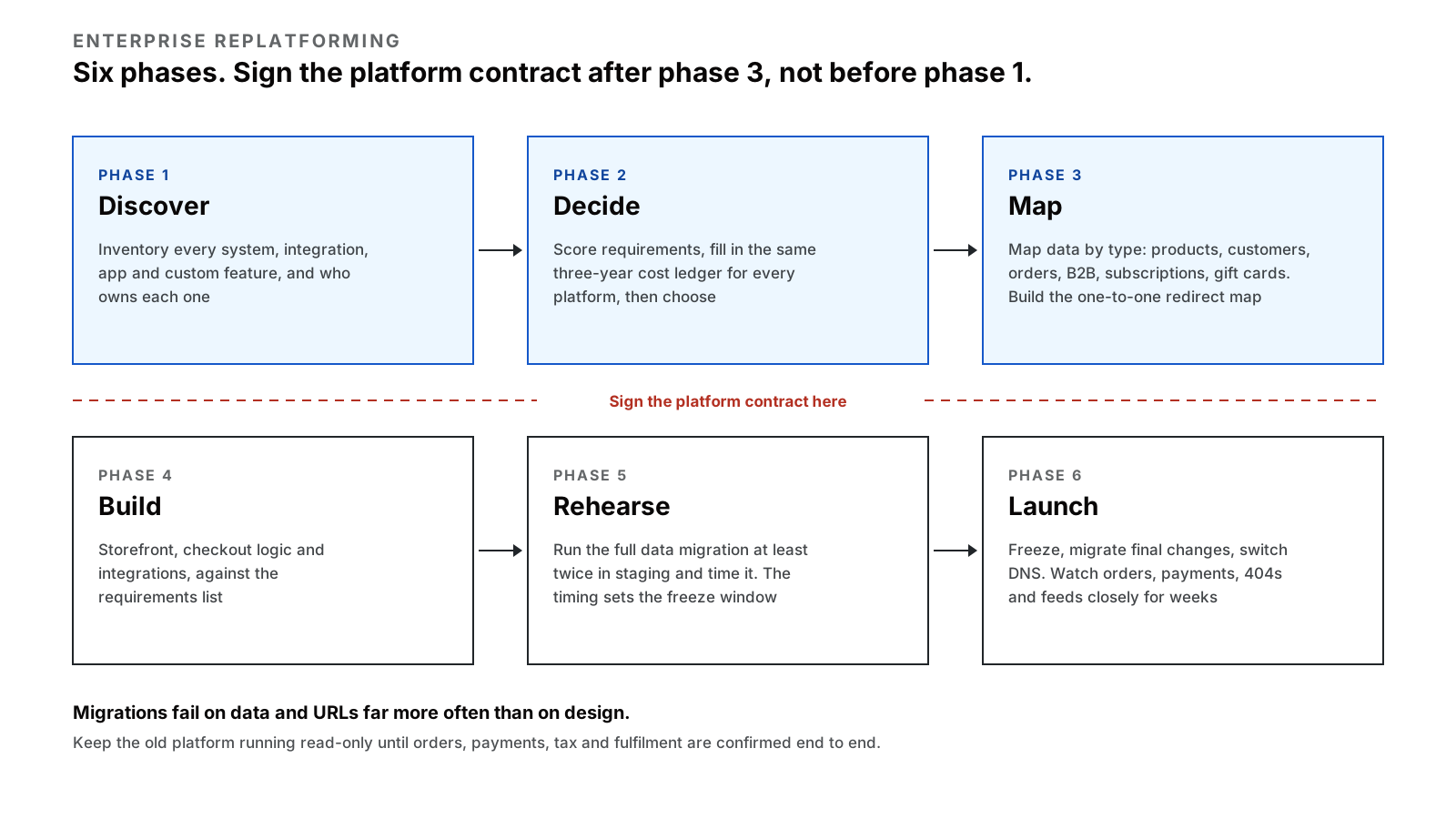
Diagram — the six phases. The platform contract belongs after phase 3, not before phase 1.
Map the data by type. Each needs its own decision:
| Data | Typical decision |
|---|---|
| Products and variants | Migrate. Check variant counts and option names against the new platform’s limits first |
| Customers | Migrate profiles. Passwords don’t carry over to Shopify, so plan an account-activation email |
| Order history | Migrate what customer service and returns need. Archive the rest |
| B2B companies and price lists | Rebuild against the new platform’s B2B model rather than copying field for field |
| Subscriptions | Move payment tokens with your payment provider’s help, or customers will have to re-enter cards |
| Gift cards and store credit | Migrate balances, and test them before launch |
| Reviews and content | Usually exported and imported by the review app or CMS |
| URLs | Map every old URL to its new one, one to one |
How do you protect SEO during a migration?
Redirect every old URL to its exact new equivalent with a 301, and launch with the full map in place. Shopify Plus holds up to 20 million redirects, imported by CSV. Shopify’s Help Center notes that “redirects only work for URLs that return 404 errors”. So a redirect can’t override a page that still exists.
Shopify also uses fixed URL patterns: products live under /products/ and collections under /collections/. Most stores moving to Shopify change almost every URL. That is manageable with a complete map, and costly without one.
On launch day and the weeks after, check:
- Search Console’s indexing report and 404s, daily for the first two weeks.
- That canonical tags,
hreflangfor each market, and structured data came across. - That product feeds for Google Merchant Center and marketplaces still validate.
- That internal links point to new URLs directly, not through redirects.
Our Shopify SEO guide covers what to set up once you’re on Shopify.
How do you rehearse and launch without losing orders?
- Run the full migration at least twice in a staging store and time it. The timing tells you how long the freeze will be.
- Agree a content and catalogue freeze for the cut-over window. Anything changed during it has to be migrated again.
- Migrate the final changes, then switch DNS at your quietest hour.
- Keep the old platform running read-only until orders, payments, tax and fulfilment are confirmed working end to end.
- Watch closely for the first weeks: order flow, payment errors, 404s, feed errors and integration queues. Have someone own each one.
When would we tell you not to move to Shopify?
We’d say stay put, or look elsewhere, if:
- your catalogue needs products with more than 2,048 variants and can’t be split;
- your custom logic lives deep in the platform’s code and can’t be rebuilt as apps, Functions or outside services;
- you need to host and control the code yourself;
- or your team is set up to run a composable stack and wants that control.
And if your current platform works, is supported, and isn’t holding sales back, a replatforming is a cost without a reason. An upgrade or a theme, app or headless change may be enough.
Where we fit
We help brands plan and build moves to Shopify, including headless builds on Hydrogen, through our Shopify headless development service; see pricing. If you’re still choosing a partner, our guide to Shopify agencies lists firms with enterprise and B2B experience. Or book a free 30-minute call and bring your requirements list.
FAQs
How much does Shopify Plus cost in 2027?
Shopify Plus costs $2,500 a month on a one-year term or $2,300 a month on a three-year term. Shopify says a variable platform fee may apply, based on revenue and business model, and doesn’t publish the rate. Using a payment provider other than Shopify Payments adds a 0.2% fee.
What is BigCommerce Enterprise called now?
BigCommerce renamed its plans on 1 June 2026: Standard, Plus, Pro and Enterprise became Core, Growth, Scale and Performance. Performance, the former Enterprise plan, is priced by quote. BigCommerce’s parent company has been called Commerce since July 2025.
Is Shopify Plus or BigCommerce better for enterprise?
It depends on your requirements. Shopify Plus allows 2,048 variants per product, 9 expansion stores and runs hosting and checkout for you. BigCommerce Performance allows 600 variants per product, several storefronts on one back end, and an open choice of payment provider under contract. Score both against your own requirements.
Is Shopify B2B only available on Shopify Plus?
No. Shopify B2B now works on the Basic, Grow, Advanced and Plus plans, including company accounts, catalogues and net payment terms. Plans below Plus are limited to 3 active catalogue assignments. Deposits, partial payments and payment requests per fulfilment are Plus-only.
When does Adobe Commerce 2.4.7 support end?
Adobe’s lifecycle policy ends standard support for Adobe Commerce 2.4.7 on 31 May 2027. Security-only support for 2.4.4 and 2.4.5 ends the same day, and Adobe stops maintaining cloud environments on unsupported versions from 1 June 2027.
How long does an enterprise replatforming take?
It depends on catalogue size, integrations and custom features, so treat any fixed number with caution. Plan six phases: discover, decide, map, build, rehearse and launch. Don’t sign a platform contract until discovery, the requirements decision and the data and redirect maps are done.
Can Shopify’s Store Migration app import from BigCommerce or Magento?
No. Shopify’s free Store Migration app imports from Square, WooCommerce, Etsy, Wix, Amazon, eBay, Clover and Lightspeed. Moving from BigCommerce, Magento, Adobe Commerce or Salesforce needs a third-party migration tool or a migration partner.
Written by Vibhora
Shopify development, branding, custom apps, SEO, paid ads and store care for small and growing brands - one team, fixed published prices.