
As of 17 November 2026, goods made in India pay the normal US import duty plus a 10% tariff, and every parcel pays it, because the US no longer lets orders under $800 in duty-free. The 50% rate of 2025 is gone. To sell from India to US customers in 2027, ship with duties paid upfront, build them into your US prices, and keep your Indian export paperwork in order.
The rules have changed five times in fifteen months, and two more US deadlines fall in January 2027. So this post starts with the status on the day it was checked, and every figure links to the government source. It isn’t legal or tax advice. Confirm your product’s duty with your customs broker or courier, and your filings with your chartered accountant.
Status, as of 17 November 2026:
| What | Where it stands | Source |
|---|---|---|
| US tariff on goods from India | The normal duty for the product, plus 10% under Section 301, since 24 July 2026 | Federal Register, 28 July 2026 |
| The 2025 tariffs (25% + 25%) | Both gone: the Russia-oil duty on 7 February 2026, the “reciprocal” tariff with the Supreme Court ruling of 20 February 2026 | Federal Register, Supreme Court |
| $800 duty-free allowance (de minimis) | Suspended for every country and every carrier, including post | CBP rule, 24 June 2026 |
| De minimis, permanently | Ends by law on 1 July 2027 | Same CBP rule, citing the One Big Beautiful Bill Act |
| India–US trade deal | Announced as a framework in February 2026, not signed | White House, 6 February 2026 |
| India Post to the US | Running since 15 October 2025, with US duty collected at booking | PIB, 14 October 2025 |
| Courier export limit of ₹10 lakh | Removed from 1 April 2026 | PIB, 31 March 2026 |
| Time to bring export payments home | 9 months from shipment (12 if invoiced in rupees), from 1 October 2026 | RBI notification |
The short version:
- Price for duty. Find your product’s US tariff code and normal duty rate, add 10%, and build it into your US price.
- Ship duties paid (DDP), so the customer never gets a bill at the door. India Post and most export couriers can do this.
- Prepare for January 2027. Two new US customs rules start on 5 and 20 January. Ask your courier how they’ll handle them.
- Keep the Indian side in order: an IEC, exports under a GST LUT, and payment realised within nine months.
- Set Shopify up for a payment provider other than Shopify Payments, which isn’t available in India.
Every parcel to the US now goes through customs with duty owed, whatever its value.
What US tariff applies to goods from India in 2027?
The normal US duty for your product, plus 10%. A presidential memorandum of 23 July 2026 directed a 10% tariff on goods from India under Section 301 of the Trade Act. It applies to goods entered from 24 July 2026, on top of the regular duty in the US tariff schedule. Pharmaceutical products are broadly exempt, and other exemptions are listed by tariff code, so check yours.
That is far lower than in late 2025, when Indian goods paid a 25% “reciprocal” tariff and a further 25% linked to Russian oil purchases. The oil-linked duty was removed from 7 February 2026. The US Commerce Department will watch India’s oil purchases, and the duty could come back. Then on 20 February the Supreme Court ruled in Learning Resources v. Trump that the emergency-powers law behind the reciprocal tariffs doesn’t allow tariffs at all.
A worked example, with an assumed rate. Suppose your product’s normal US duty is 12% (look up your own; it varies by product):
| On a $60 order | Amount |
|---|---|
| Normal duty, 12% (assumed) | $7.20 |
| Section 301 tariff, 10% | $6.00 |
| Duty owed | $13.20, plus any carrier or customs fee |
Three things could still move the rate. The February trade framework promised an 18% rate and removals for some goods, but it rested on the tariffs the court struck down and no deal has been signed. The Section 301 tariffs are being challenged at the US Court of International Trade. And a separate US trade investigation that includes India is reported to be due in 2027. Recheck before you set prices for the year.
Is the $800 de minimis exemption gone?
Yes. The US stopped letting parcels under $800 in duty-free on 29 August 2025, for every country. After the Supreme Court ruling, US Customs and Border Protection (CBP) kept the suspension in place under its own powers. Its June 2026 rules apply it to couriers and to post alike. The One Big Beautiful Bill Act ends the exemption permanently on 1 July 2027.
What that means for an Indian brand: every US order now owes duty, even a $15 one. The US customer pays it, unless you pay it upfront. If they’re asked to pay at the door, many refuse the parcel, and you pay for the return.
Two CBP rules land in January 2027, and both change how shipments are cleared:
- 5 January 2027: foreign sellers who act as the US importer of record must be validated under CBP’s CTPAT programme, or use a CTPAT-validated, licensed customs broker (CBP rule, 6 November 2026). If you ship DDP under your own name, ask your courier or broker who the importer of record is.
- 20 January 2027: postal shipments that owe special tariffs, or that need checks by agencies such as the FDA, must be cleared through formal entry (CBP rule, 22 October 2026). The 10% Section 301 tariff is one of those special tariffs, so this likely covers most posted goods from India. Ask India Post or your broker how they will clear them from that date.
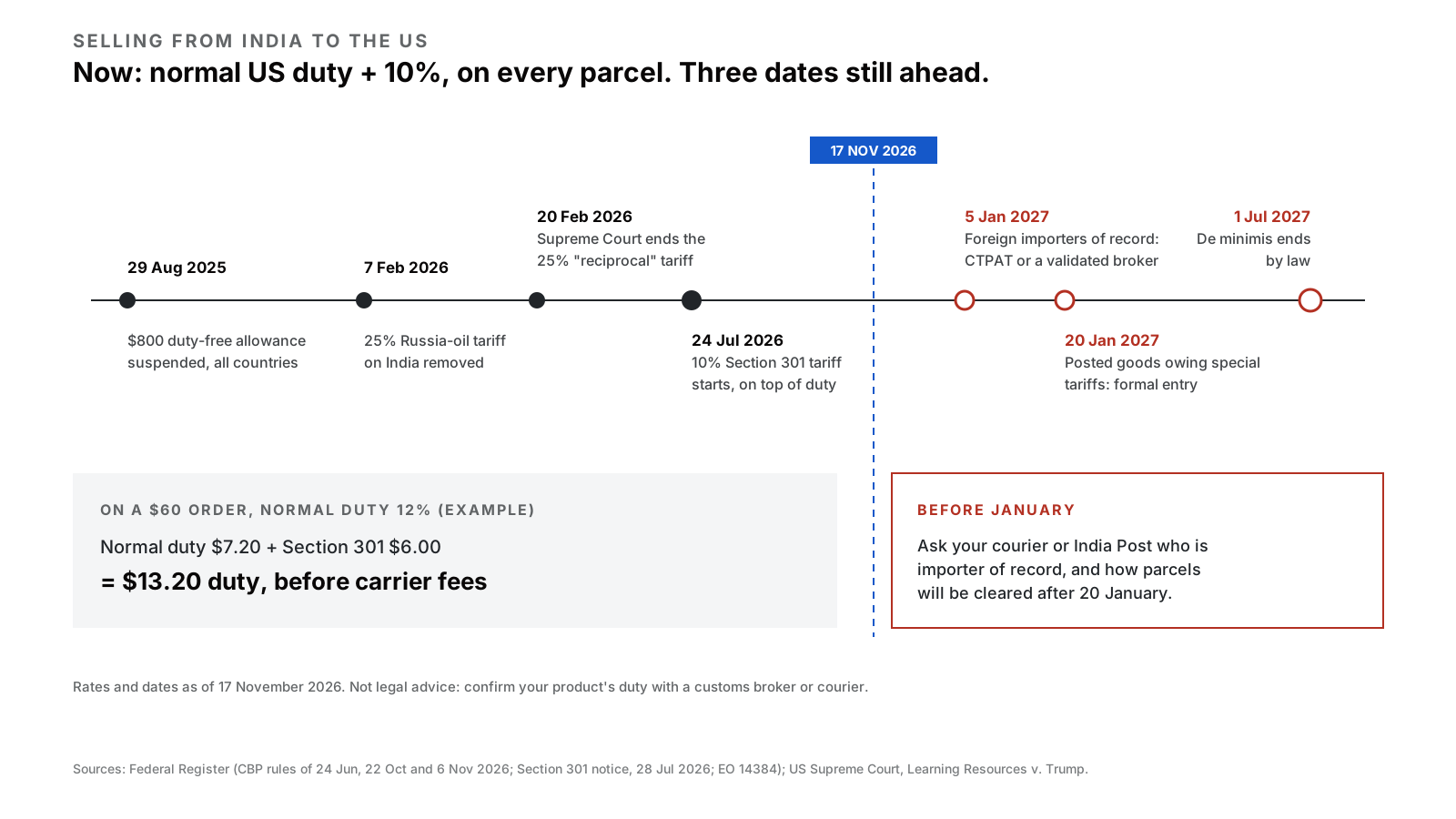
Diagram — the US rules for Indian goods, 2025 to 2027. The three 2027 dates are still ahead.
Should you ship with India Post or a courier?
Both can deliver with US duty paid upfront. The difference is price, speed, tracking and how much of the paperwork they handle.
| India Post | Export courier or aggregator | |
|---|---|---|
| Duty | Collected “upfront in India at the time of booking” and sent to CBP, with no extra charge for the service (PIB) | Most offer DDP. ShiprocketX, for example, says “DDP is auto-applied when you create a USA shipment” (Shiprocket) |
| Where to book | Any post office, International Business Centre, Dak Ghar Niryat Kendra, or online | The carrier’s or aggregator’s dashboard, usually with a Shopify app |
| Value limit | Postal limits apply | The ₹10 lakh limit per commercial courier shipment was removed from 1 April 2026 |
| January 2027 | Ask how posted goods owing the 10% tariff will be cleared after 20 January | Ask who acts as importer of record after 5 January |
India Post suspended most US parcels from 25 August 2025 and resumed all categories on 15 October 2025. Its October 2025 notice quoted the old 50% rate. We couldn’t find a newer notice giving the current basis, so confirm the amount at the counter.
Couriers usually cost more per parcel but give tracking, faster delivery and help with paperwork. For most D2C brands the deciding question is simple: who will clear your parcels after January 2027, and in whose name?
What paperwork do you need in India to export?
- An IEC (Importer Exporter Code) from the DGFT. The DGFT says it is “mandatory for undertaking any export/import activities”. Payment providers ask for it too: Razorpay requires one before it accepts international payments for physical goods.
- A GST Letter of Undertaking (LUT), filed each financial year. Exports are zero-rated, so with an LUT you export without paying IGST and claim a refund of input tax credit instead. Your CA files it on the GST portal.
- The right customs description and tariff code on every shipment, matched to the US code you priced for.
- Payment brought home within nine months. Under the RBI’s export regulations in force from 1 October 2026, export proceeds must be realised within nine months of shipment, or twelve if invoiced in rupees. Shipping bills up to ₹10 lakh can be closed on your own declaration.
- A returns plan. The April 2026 courier reforms added a formal return-to-origin process and simpler re-import for returned goods. Ask your courier how to use it.
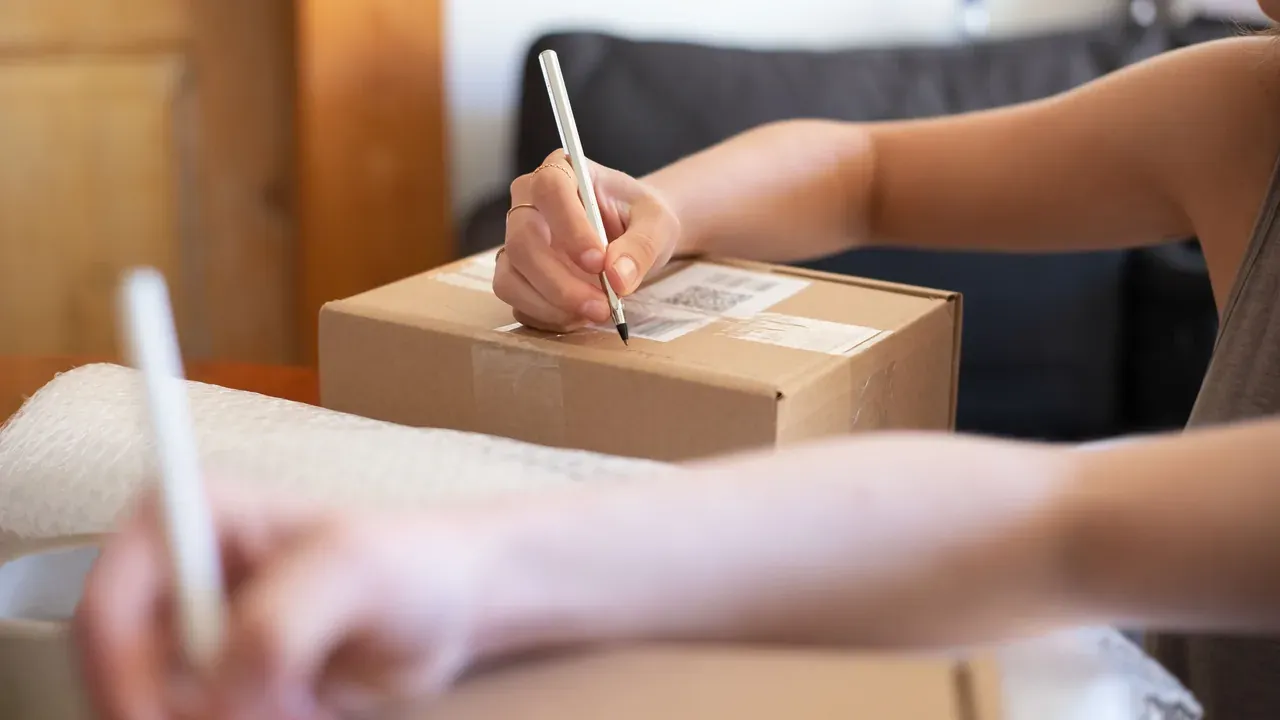
Every parcel needs an honest description and the right tariff code. The duty is worked out from them.
How do you set up a Shopify store to sell to the US from India?
Shopify Payments isn’t available in India, according to Shopify’s list of supported countries, so you need another payment provider. That affects three things:
- Payments. Razorpay documents international payments on Shopify. Stripe has been “invite-only in India” since 2024. If you use PayPal, check its current terms for Indian sellers.
- Currency. Shopify’s Help Center says selling in multiple currencies needs Shopify Payments. With another provider, every customer pays in the store’s default currency. Brands that sell mainly to the US often run a separate store priced in US dollars. Check that your payment provider can charge in dollars first.
- Duties at checkout. Shopify’s feature for charging duties at checkout works fully only for stores on Shopify Payments. Its help page says: “Only stores using Shopify Payments with access to one-page checkout can use all functionalities.” The simpler route for an Indian store is to build the duty into your US prices and ship DDP.
Shopify’s Managed Markets, where a partner handles duties and becomes the seller of record, is “only available to merchants based in the continental United States”, plus some Canadian and UK stores. Indian stores aren’t eligible.
Then on the storefront:
- Say prices include duty, on product pages and at checkout. It’s the strongest reason a US customer will trust an overseas store.
- Show delivery times honestly for each shipping option.
- Write a returns policy that works across borders: who pays return postage, and whether you refund or replace.
Do you need to collect US sales tax?
Possibly, once your sales into a US state pass its threshold. Since the Supreme Court’s 2018 Wayfair decision, states can require remote sellers to collect sales tax once sales into the state pass a threshold. $100,000 a year is common, as in Arizona, and some states also count transactions. The thresholds are based on sales into the state, not where the seller is based. Marketplaces such as Amazon and Etsy collect the tax on their own sales; sales on your own Shopify store are your responsibility. Track sales by state from the first order.
What US rules apply to common Indian D2C products?
| Category | What the US requires |
|---|---|
| Clothing and textiles | Labels must show fibre content, country of origin and the maker. Online listings must state the country of origin too (FTC) |
| Cosmetics and skincare | Facilities that make cosmetics for the US must register with the FDA, and each product must be listed, with a small-business exemption except for higher-risk products (FDA) |
| Food, tea, spices and snacks | FDA prior notice is required for food sent by courier or post, with the confirmation number on the customs declaration for mail (FDA) |
Food and cosmetics also fall under the 20 January 2027 postal rule, because they need FDA checks. If you sell them by post, plan the clearance route before January.
What should you do before January 2027?
- Look up the US tariff code and normal duty rate for each product you sell, and add the 10%.
- Reprice your US store with duty built in, and say so on the page.
- Ask your courier or India Post in writing who will be importer of record after 5 January, and how posted goods owing the 10% tariff will be cleared after 20 January.
- Check your IEC, LUT and the nine-month payment window with your CA.
- Check the category rules for textiles, cosmetics or food.
- Put 1 July 2027 in the calendar, when de minimis ends by law, and recheck the tariff whenever a trade deal is signed.
Our profitable products guide shows how duty changes a product’s margin. For India’s own privacy rules, see our DPDP Act guide for Shopify stores.
How we can help
Rules like these change every few months, and someone has to keep the store in step: prices, product data, shipping settings, policy pages. That’s what our monthly store retainers cover; see pricing. Or book a free 30-minute call and we’ll look at your US setup with you.
FAQs
What is the US tariff on goods from India in 2027?
As of 17 November 2026, goods from India pay the normal US duty for their tariff code plus a 10% Section 301 tariff, in force since 24 July 2026. The 50% combined rate of late 2025 no longer applies. Pharmaceutical products are broadly exempt, and other exemptions are listed by tariff code.
Is the $800 de minimis exemption still available for parcels from India?
No. The US suspended the $800 duty-free allowance for all countries on 29 August 2025, and CBP’s June 2026 rules keep it suspended for couriers and post alike. The One Big Beautiful Bill Act ends it permanently on 1 July 2027.
Can India Post ship parcels to the US?
Yes. India Post resumed all categories of US-bound parcels on 15 October 2025, after suspending most of them in August. US customs duty is collected upfront in India at booking, with no extra service charge. Confirm the current amount at booking, and ask how posted goods will be cleared after 20 January 2027.
Do I need an IEC to sell to US customers from my Shopify store?
In most cases, yes. The DGFT says an Importer Exporter Code is mandatory for exports, and payment providers such as Razorpay ask for one before accepting international payments for physical goods. Check the exemptions in the DGFT’s procedures with your CA.
Can an Indian Shopify store use Shopify Payments?
No. Shopify Payments isn’t available in India, so Indian stores use a third-party provider such as Razorpay. Without Shopify Payments, customers pay in the store’s default currency, and Shopify’s duties-at-checkout feature doesn’t work in full.
How long do I have to receive payment for exports from India?
Under the RBI’s export regulations in force from 1 October 2026, export proceeds must be realised within nine months of shipment, or twelve months if the export is invoiced in rupees. Shipping bills up to ₹10 lakh can be closed on the exporter’s own declaration.
What changes for Indian sellers in January 2027?
Two US customs rules start. From 5 January 2027, foreign sellers acting as importer of record must be CTPAT-validated or use a validated, licensed customs broker. From 20 January 2027, posted goods owing special tariffs, or needing checks by agencies such as the FDA, must be cleared through formal entry.
Written by Vibhora
Shopify development, branding, custom apps, SEO, paid ads and store care for small and growing brands - one team, fixed published prices.