
Most “profitable products to sell online” lists print a category name next to an invented margin percentage and move on. This one does the opposite: a framework for evaluating any product idea against demand, margin, competition and risk, real unit economics you can run your own numbers through, and — the thing most 2026 versions of this article are skipping — what the end of the US de minimis import exemption actually does to dropshipping’s margins if you’re sourcing from China.
A framework, not a fixed list
“Profitable” depends on your specific costs, so a single ranked list of products is close to meaningless without your own numbers behind it. Evaluate any product idea against six factors instead:
| Factor | What to check |
|---|---|
| Demand | Is there sustained search/purchase interest, or a spike that’s already fading? |
| Margin potential | Unit cost vs. realistic sale price, before you’ve added shipping, payment processing or ad cost |
| Competition | How many established sellers already own this exact product, and on what channels |
| Return risk | Size/fit-dependent categories (apparel, footwear) carry structurally higher return rates than accessories |
| Regulatory complexity | Electronics, cosmetics, supplements and children’s products carry compliance requirements a phone case doesn’t |
| Sourcing/shipping complexity | Unit weight and fragility drive shipping cost and damage-return rate directly |
A product that scores well on demand and margin but poorly on regulatory complexity or return risk isn’t automatically a bad idea — it’s a different kind of business, with different operational overhead, and the framework’s job is to make that visible before you commit inventory budget to it.
Where the demand numbers actually come from
Trend data ages fast, and most “trending products” listicles print a specific percentage margin with no visible source — a pattern worth being skeptical of rather than repeating. For genuinely current demand signals, check the primary sources yourself rather than trusting any snapshot, including this one: Google Trends for search interest over time, Adobe’s Digital Economy Index for category-level US ecommerce spending data, and your own target marketplace’s best-seller/trending pages for real-time signal.
One category-level data point worth knowing as of this writing: online grocery sales grew more than 20% year-over-year in Q1 2026, and Adobe Analytics recorded 10.2% year-over-year growth in online grocery spending during the 2025 holiday season — a genuinely fast-growing category, distinct from the more saturated “trending products” categories (phone accessories, novelty items) that dominate most lists. Whether that’s a fit for your business depends on fulfillment capability (grocery has real cold-chain and shelf-life constraints most dropshippers can’t meet), not just the growth number.
Sources: Digital Commerce 360 (Q1 2026 online sales analysis), Adobe Analytics holiday shopping data.
Category-level reasoning, not a percentage claim
Rather than asserting a specific margin percentage per category — which is exactly the unsourced pattern this rewrite is avoiding — here’s the structural reasoning for why certain categories tend to run higher margins, so you can apply it to whatever you’re actually considering:
- Low unit cost relative to perceived value. A product that costs little to produce but solves a specific, valued problem (organization, a gift occasion, a specific hobby need) supports a retail price well above its input cost — this is a structural property, not a category-specific secret.
- Low shipping weight and low fragility. Shipping cost and damage-related returns eat directly into margin; a lightweight, durable product protects margin that a heavy or fragile one gives back immediately.
- Evergreen demand over fad demand. A seasonal or trend-driven spike (visible clearly on Google Trends as a sharp peak and decline) is a worse foundation for a sourcing/inventory commitment than steady, year-round search interest, even if the fad’s peak margin looks better on paper.
- Differentiation potential. A commodity product with dozens of identical listings on every marketplace competes almost entirely on price; a product you can brand, bundle or customize protects margin that a race-to-the-bottom category can’t.
Commonly cited examples that fit this reasoning — accessories and add-ons (phone/tech accessories, jewelry, pet accessories), personalized/customizable goods, and beauty tools — show up across most “profitable product” lists for a real structural reason, not because of a specific verified margin figure. Treat any of them as a starting hypothesis to validate with your own numbers (below), not a guaranteed outcome.
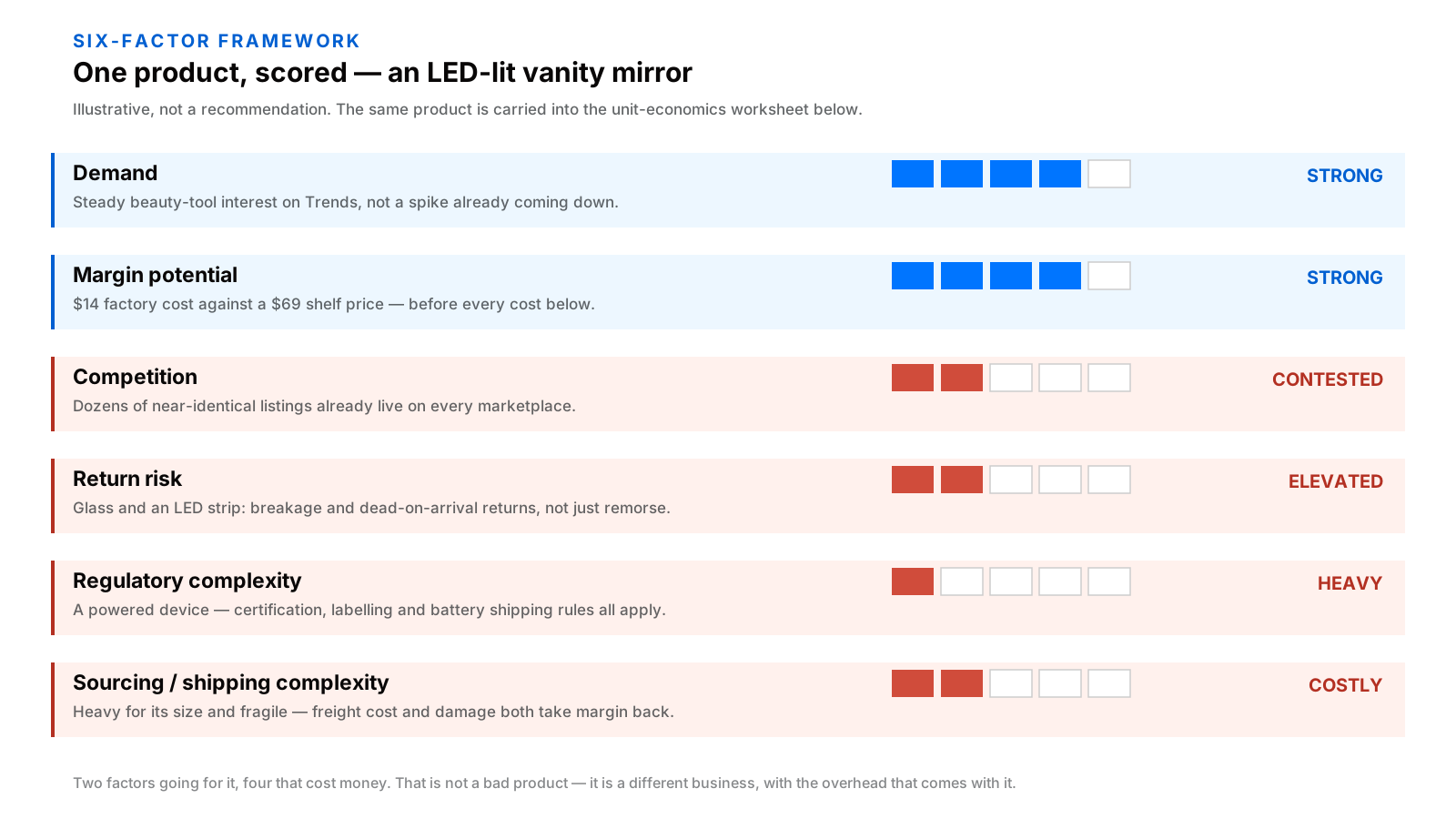
Diagram — one sample product scored against the six factors above. Illustrative, not a recommendation: two factors go for it and four cost money, which is the trade-off the framework exists to make visible. The same product carries into the worksheet below.
A real unit-economics worked example
Run your own product through this, not the example numbers:
- Landed cost = unit cost + inbound shipping + duties/tariffs (see the section below — this line changed materially in 2025) + any per-unit fulfillment fee.
- Target gross margin — a common starting target for a new DTC product is 50–65% gross margin before marketing spend, though this varies enormously by category (grocery and low-differentiation commodities run much thinner; highly differentiated or branded goods can run higher).
- Marketing-adjusted margin — subtract a realistic customer acquisition cost. If you don’t have your own data yet, model at least two scenarios (a conservative and an aggressive CAC assumption) rather than one optimistic number — this is the single most common place a “profitable on paper” product turns out not to be.
- Payment processing — 2.5–2.9% + a fixed per-transaction fee is a reasonable planning assumption on Shopify (see the exact current rates in the store setup guide).
- Return/refund reserve — model a return rate appropriate to the category (low for accessories, meaningfully higher for apparel/footwear) as a cost line, not an afterthought.
If the number that survives all five steps is still a margin you’d actually operate on, the product has cleared the first real test — everything before this point is a hypothesis.
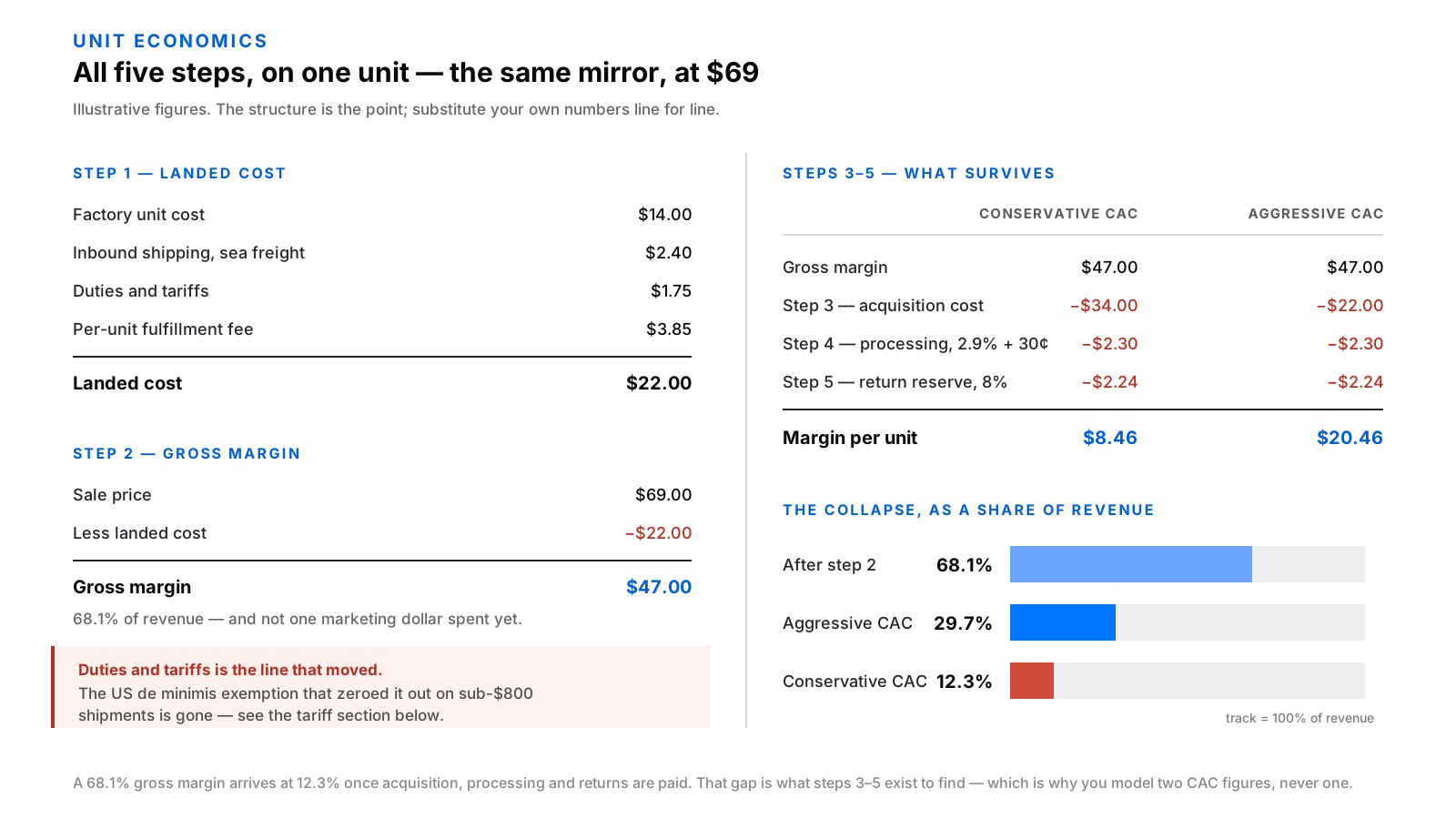
Worksheet — the five steps above, run end to end on that product. A 68.1% gross margin arrives at 12.3% once acquisition, processing and returns are paid, which is why step 3 asks for two CAC scenarios rather than one. Illustrative figures; the structure is what to copy.
Validating demand before you buy stock
- Check search trend stability, not just volume — a keyword at 10,000 monthly searches climbing steadily is a better signal than one at 50,000 searches that’s already declining from a spike.
- Run a small, real ad test before committing to inventory — a landing page and a modest ad budget will tell you more about actual purchase intent than any trend chart.
- Consider a pre-order or waitlist for a higher-cost or made-to-order product, so you’re validating demand with real commitment, not just page views.
- Check existing marketplace listings for your exact product idea — review counts and listing age tell you how contested the space already is.
Supplier and sourcing checklist
- Request samples before committing to a bulk order — photos from a supplier listing are not a quality guarantee
- Confirm minimum order quantities and lead times in writing
- Verify the supplier’s compliance documentation for regulated categories (electronics certifications, cosmetics ingredient documentation, children’s product safety standards)
- Get landed cost in writing, including shipping method and current duties — not just factory-gate price
- Check for existing negative supplier reviews on B2B sourcing platforms before ordering, not after a bad batch arrives
Inventory vs. dropshipping vs. wholesale vs. white-label vs. POD
| Model | Upfront capital | Margin potential | Control over quality/branding | Fulfillment speed |
|---|---|---|---|---|
| Buy inventory upfront | High | Highest | High | Fastest (you control stock) |
| Dropshipping | Low | Lowest (see below) | Low, unless supplier allows branding | Slowest, least reliable |
| Wholesale (buy branded goods to resell) | Medium | Medium | None (reselling someone else’s brand) | Fast |
| White-label / private label | Medium–high | High | High | Depends on production lead time |
| Print-on-demand (POD) | Very low | Medium | Medium (design control, not product control) | Slower, per-order production |
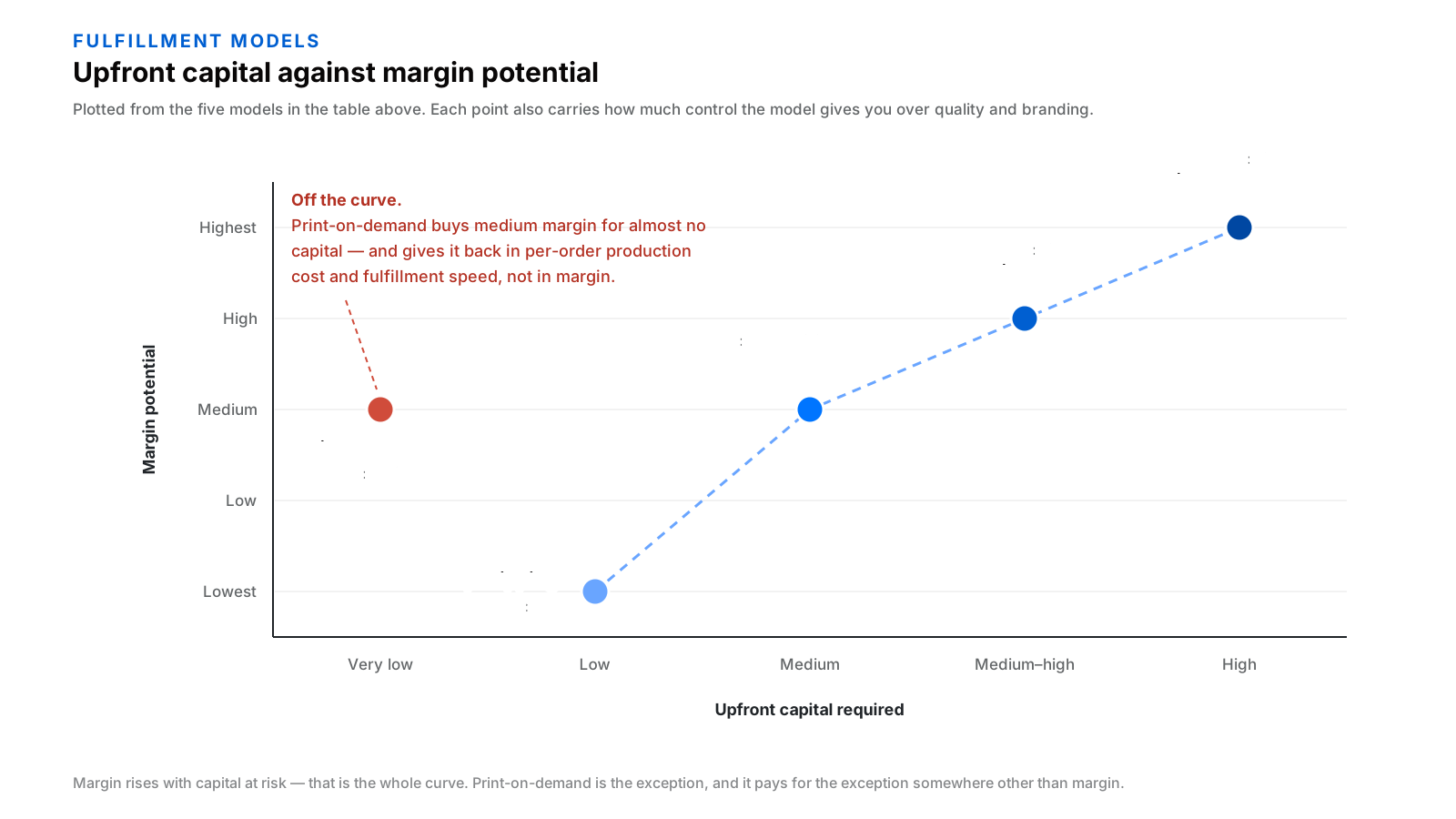
Diagram — the five models above, plotted by upfront capital against margin potential, with each model’s control over quality and branding noted beside it. Margin rises with capital at risk; print-on-demand is the one exception, and it pays for the exception in per-order cost and fulfillment speed rather than in margin.
Is dropshipping still profitable?
The honest answer changed materially in 2025, and most articles on this topic haven’t caught up. The US de minimis exemption — which let low-value shipments (under $800) enter the US without duties, and was the economic foundation of most direct-from-China dropshipping — was eliminated for China and Hong Kong on May 2, 2025, then suspended for all countries on August 29, 2025. Shipments that previously entered duty-free now face real tariff costs, and the “One Big Beautiful Bill Act,” signed into law July 4, 2025, terminates the de minimis exemption entirely (a statutory change, not an executive order that a future administration could simply reverse) effective July 1, 2027.
What this actually means for a dropshipping business model: landed cost on goods sourced directly from China is now structurally higher than the classic 2015–2024-era dropshipping playbook assumed. Recalculate your unit economics (above) using current duty rates for your specific product category and origin country — not the margin assumptions in an older guide, including the previous version of this one. Dropshipping isn’t dead, but the “$2 item, sell for $25, keep the difference” version of the pitch was already optimistic before this change and is meaningfully less accurate now. Models with more control over cost — white-label, domestic or nearshore suppliers, or holding your own inventory — are comparatively more attractive than they were before this change, precisely because they were never depending on a duty exemption that’s now gone.
Sources: Practical Ecommerce, Morgan Lewis (May 2025 client alert on the de minimis exception elimination), Avalara.
Channel suitability
- Shopify (your own store) — full control over branding, margin and customer data; you own the acquisition cost entirely, which is the tradeoff for that control. See the store setup guide if you’re building here.
- Amazon and other marketplaces — built-in demand and trust, at the cost of margin (referral fees, fulfillment fees if using FBA) and much weaker brand/customer-data control. Prerequisites for adding Amazon alongside a Shopify store are covered in the store setup guide’s sales-channels section.
- Social commerce (TikTok Shop, Instagram/Meta Shopping) — strong fit for visually demonstrable, impulse-friendly products with genuine content potential; weaker fit for considered, high-price purchases.
Regulatory, quality, return and seasonality risk
- Customs and duty compliance is now a real operational requirement, not a formality, for anything crossing an international border into the US — confirm your supplier or freight forwarder is using the correct current entry process; low-value postal entry types that used to apply to China/Hong Kong shipments are no longer accepted the way they were before May 2025.
- Regulated categories (electronics, cosmetics/skincare, supplements, children’s products) carry certification and labeling requirements that vary by destination market — confirm compliance before listing, not after a marketplace takedown.
- Seasonality — a product with a hard seasonal peak (holiday decor, specific gift-occasion items) needs an inventory and cash-flow plan built around that peak, not a flat year-round assumption.
Launch test and minimum viable budget
Before committing to bulk inventory: run the unit-economics worked example with real supplier quotes, validate demand with a small ad test and/or a pre-order, and order a limited first batch (or use a POD/dropship test phase, understanding its now-higher landed cost) sized to what you can sell out and re-evaluate within a defined window — 4–8 weeks is a reasonable first checkpoint for most categories. A launch that requires a large inventory commitment before any real demand validation is the single riskiest version of this process, regardless of which product you’ve chosen.
FAQs
Is dropshipping still profitable in 2026?
It can be, but the economics changed in 2025 — the US de minimis exemption that made ultra-thin-margin China-direct dropshipping work is gone for China/Hong Kong already and set to end entirely for all countries by mid-2027. Recalculate your unit economics with current duty rates before assuming a margin that a pre-2025 guide promised.
What’s a realistic profit margin for a new online product?
There’s no single honest percentage that applies across categories — a commodity accessory and a differentiated, branded product have very different structural margin potential. Run the unit-economics steps in this guide with your own supplier quotes rather than trusting a category-wide percentage from any single source, including this one.
How do I know if a trending product is a real opportunity or a fading fad?
Check the trend’s shape, not just its current volume — a keyword climbing steadily over months is a better signal than one spiking sharply and already declining. Google Trends’ “interest over time” view makes this distinction visible in under a minute.
Should I buy inventory upfront or start with dropshipping?
Dropshipping has the lowest upfront capital requirement but now also the thinnest margin, given the tariff changes above, plus the least control over fulfillment speed and quality. If you can validate demand with a smaller upfront inventory commitment or a white-label/POD model instead, you generally get a more defensible margin — the tradeoff is capital and lead time, not skill.
Written by Vibhora
Design-first, performance-focused Shopify development, migrations and optimization for ambitious brands.