For most small Shopify stores in 2027, the order to spend in is:
- Google’s free listings, which cost nothing.
- Google Shopping or Performance Max, to catch people already searching for what you sell.
- Meta’s Advantage+ sales campaigns, to find people who aren’t searching yet.
- ChatGPT Ads, but only once the first three work, and only as a small test.
Two things have changed underneath every channel. Ads cost more: Meta’s average price per ad rose 14% year on year in the third quarter of 2026 (Meta’s results). And the platforms now automate the targeting. A small store can’t out-target Meta’s or Google’s algorithms. It competes on what it feeds them: clean product data, enough creative to test, and accurate conversion tracking.
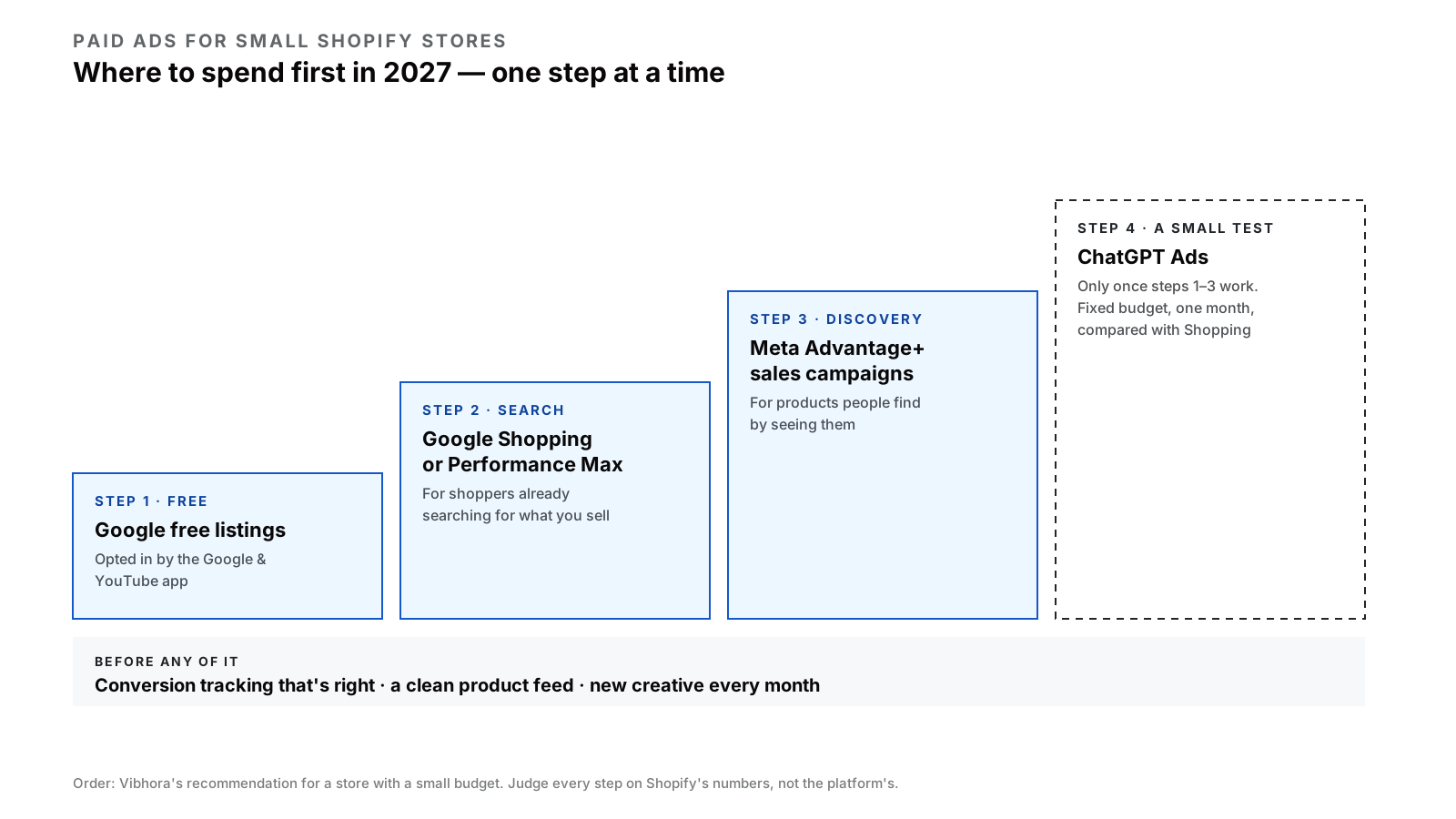
Diagram — the spending order, one step at a time. The foundation matters more than any single step.
Which ad channel suits a small Shopify store?
| Channel | Best for | Shopify setup | US | UK | India |
|---|---|---|---|---|---|
| Google free listings | Free visibility for every product | Google & YouTube app (opted in automatically) | Yes | Yes | Yes |
| Google Shopping / Performance Max | Shoppers already searching | Google & YouTube app | Yes | Yes | Yes |
| Meta Advantage+ sales | Discovery for visual, impulse-friendly products | Facebook & Instagram app | Yes | Yes | Yes |
| ChatGPT Ads | Shoppers asking for recommendations | ChatGPT Ads app (US only) or Ads Manager | Beta | Beta | Beta |
| TikTok | Products that sell on short video | TikTok app; TikTok Shop channel | Yes | Yes | No — TikTok is blocked in India |
| Shopify Campaign Autopilot | Running Meta and others from the Shopify admin | Built in, free on paid plans | Yes | Yes | Yes |
| Shop Campaigns | Paying only for new customers | Shop channel; needs Shopify Payments | Yes | Check eligibility | No |
Our view, not a platform rule: if your monthly ad budget is small, run one paid channel properly rather than three badly. For most stores, that channel is Google Shopping for products people search for by name or type, or Meta for products people discover by seeing them.
Is advertising more expensive for small stores in 2027?
Yes. Meta’s average price per ad rose 14% in the third quarter of 2026, with impressions up 10%. Benchmarks from LocaliQ, which sells advertising services, give a sense of typical costs:
| Channel and category | Cost per click | Conversion rate |
|---|---|---|
| Google search ads, all industries | $5.42 | 8.18% |
| Google search ads, shopping, collectibles and gifts | $4.14 | 4.01% |
| Google search ads, apparel, fashion and jewellery | $4.44 | 4.50% |
| Facebook traffic campaigns, all industries | $0.60 | — |
| Facebook traffic campaigns, apparel | $0.71 | — |
| Facebook traffic campaigns, beauty | $0.50 | — |
Sources: LocaliQ’s search advertising benchmarks (2026) and Facebook advertising benchmarks (September 2026). These are averages across LocaliQ’s clients, not targets. A click from Facebook is cheap because it is low-intent; a Google search click costs more because the shopper is closer to buying.
Rising costs mean wasted spend hurts more. The biggest sources of waste on a small store are usually not the ad settings. They are a product page that doesn’t convert, tracking that misses sales, and creative that has run for months.
How should a small store run Meta ads in 2027?
Use Advantage+ sales campaigns. Meta has renamed its automated shopping campaigns “Advantage+ sales campaigns”. They “drive sales by optimizing across creative, targeting, placements, budget and destination”, and Meta can test up to 150 creative combinations from the ads you import. For a small store that means:
- Target broadly. Meta’s own guidance is to set little more than location and let its audience tools do the rest. Narrow interest targeting mostly limits the algorithm.
- Feed it creative. The algorithm needs options: several images and short videos per product, refreshed regularly. Meta’s newer AI tools can turn images into video and generate variations.
- Send it accurate conversions. In Shopify’s Facebook & Instagram app, set data sharing to Maximum (Sales channels > Facebook & Instagram > Settings > Data sharing). That uses Meta’s Conversions API alongside the pixel, which “sends the purchase event between Shopify and Facebook servers” rather than relying on the browser alone.
Two 2026 changes affect how Meta reports results:
- Fewer attribution windows. On 12 January 2026, Meta stopped returning its 7-day and 28-day view-through windows.
- Stricter click counting. In March 2026, click-through attribution changed to count link clicks only.
Expect Meta to claim fewer conversions than it did in 2025, with no change in what you pay. Compare periods carefully.
One more thing has changed since 2025: Facebook and Instagram shops no longer have their own checkout. Since August 2025, “customers are now redirected to the online store to complete their purchase”. Your product page and checkout do the converting, so their speed and clarity matter as much as the ad.
How should a small store run Google ads in 2027?
Start with free listings. Google’s free listings still let eligible products “appear across Google for free”, and Shopify stores using the Google & YouTube app are opted in automatically. If your products aren’t showing, the cause is usually in Merchant Center: a missing GTIN, a policy issue, or shipping settings.
Then Shopping or Performance Max. Standard Shopping campaigns show your products to people searching for them. Performance Max adds YouTube, Display and other Google surfaces, with more automation and less control. Google’s newer AI Max for Shopping, still in beta, rewrites ad text from your product feed and can send shoppers to a different page on your site than the one you set. Two limits matter:
- Its URL feature needs Target ROAS bidding. Final URL expansion is “only available with a Target ROAS bid strategy”.
- Its text feature is English-only for now. Text customisation works only on English feeds.
Get conversion tracking right. The Google & YouTube app sets purchase, add-to-cart and checkout-started as the default conversion actions. Turn on enhanced conversions in the app’s settings, and remove any older Google tags pasted into your theme, which would double-count sales.
Fix your feed before your bids. Google Shopping runs on product data. Titles that say what the product is, complete attributes, GTINs and good images do more than bid adjustments. From 31 January 2027, Merchant Center enforces a 500×500 pixel minimum for product images, so upload 1500×1500 or larger.
Are ChatGPT Ads worth it for a small store?
Verdict: worth a small test in 2027, not a main channel.
OpenAI started testing ads in ChatGPT in early 2026 and has opened a self-serve ChatGPT Ads Manager, still labelled beta. For Shopify stores, OpenAI publishes an official ChatGPT Ads app, free to install, that syncs your product catalog to Ads Manager and adds a tracking pixel. OpenAI’s help centre says the Shopify app is available to US stores. Other countries use Ads Manager directly.
What a small store should know:
- Bidding: campaigns can use a fixed bid, maximise clicks or maximise conversions. You pay per click on click campaigns (OpenAI’s developer docs).
- Tracking: OpenAI offers a pixel and a Conversions API, and deduplicates events sent through both (conversion tracking docs). Set it up before spending, or you won’t know whether it worked.
- Budget: OpenAI’s help centre lists a daily minimum of $25 a campaign in the US. Check the current figure in Ads Manager before you plan around it.
- Restrictions: OpenAI’s ad policies exclude several categories and keep ads away from sensitive conversations. Check them before building a campaign, especially for health or financial products.
The case for testing it: product-feed ads appear when someone asks ChatGPT for a recommendation, which is high-intent. The case for caution: it’s new, the audience on the ad-supported plans is limited, and there are no independent benchmarks yet. Spend a small fixed amount for a month, compare it with Google Shopping on cost per order, and decide from your own numbers.
Is TikTok worth it for a small Shopify store?
For products that sell on short video, such as beauty, fashion, gadgets and gifts, yes. TikTok’s ads for TikTok Shop now run through a single automated campaign type, GMV Max. For your own website, the TikTok app for Shopify installs TikTok’s pixel and Events API and syncs your catalog. TikTok’s minimum budgets are higher than Meta’s: TikTok’s help centre lists more than $50 a day per campaign.
Two limits:
- Where TikTok Shop works. TikTok Shop through Shopify is available to stores in ten countries, including the US and the UK.
- India. TikTok has been blocked there since June 2020, so it is not an option for Indian audiences.
What ad tools does Shopify offer itself?
Shopify has built its own advertising tools into the admin:
- Campaign Autopilot, launched in June 2026 and now available to all merchants, runs campaigns on Meta, Microsoft Advertising, Snapchat and Shop Campaigns from the Growth tab. It is free on paid Shopify plans. For Meta it recommends Advantage+ campaigns and sets up the Conversions API. The budget is a spend target and can be exceeded, so watch it.
- Shop Campaigns show your products in the Shop app and across Shopify’s network, and you “pay only for successful customer acquisitions” at an average acquisition cost you set. It requires Shopify Payments and Shop’s direct checkout, and it isn’t available in every country.
- Shopify Audiences, which builds audiences for retargeting from Shopify’s network, is only available on Shopify Plus, with Shopify Payments, in the US and Canada.
For a store without anyone managing ads, Campaign Autopilot is a reasonable way to start on Meta without learning Ads Manager. It doesn’t cover Google, so pair it with the Google & YouTube app.
Why don’t the ad platforms’ numbers match Shopify’s?
Because each one counts differently. Shopify’s marketing reports use last non-direct click by default and look back up to 30 days. Shopify warns that “each platform credits sales by using its own rules… each platform can count the same sale”. Add up what Meta, Google and TikTok each claim, and the total is often more than your actual sales.
Use one source of truth for decisions: Shopify’s orders, revenue and new customers. Judge each channel by what changes when you raise or cut its spend, not by the number it reports about itself.
Privacy rules widen the gap in some markets. For visitors in the EEA, the UK and Switzerland, Google needs Consent Mode v2 and valid consent before it can use the data for personalised ads or enhanced conversions. Shopify’s cookie banner handles the consent, and Google says consent mode turns on automatically once the banner is enabled (Google). Expect fewer reported conversions from those visitors, and more modelled ones.
What’s different for advertisers in India?
- GST on ad spend. Google charges 18% GST on ads billed in India (IGST, or CGST plus SGST for Haryana addresses), and a GSTIN is mandatory for business accounts. Meta ads billed in India also carry GST.
- The equalisation levy is gone. The 6% levy on payments to foreign online advertising platforms no longer applies to payments made from 1 April 2025.
- Payments. Both Google and Meta offer prepaid options, including UPI, because of RBI rules on automatic card charges.
- Fewer channels. TikTok is blocked, and Shop Campaigns, Shopify Audiences and the ChatGPT Ads Shopify app aren’t available to Indian stores. Google Shopping, free listings and Meta are the core.
A starting plan for a small Shopify store
- Fix the basics first: product page speed, a delivery estimate on the product page, and a checkout you’ve tested on a phone. Ads multiply whatever conversion rate you already have.
- Set up tracking properly: Meta data sharing on Maximum, enhanced conversions in the Google & YouTube app, and no duplicate tags in the theme.
- Clean your product feed: clear titles, full attributes, GTINs, and images of at least 1500×1500 pixels.
- Start one paid channel: Google Shopping for searched-for products, or Meta Advantage+ for discovered ones. Run it for at least a month before judging.
- Make creative a monthly habit: new images and short videos every month, even simple ones.
- Judge on Shopify’s numbers: cost per new customer and contribution margin, not platform-reported ROAS.
- Then test something new: a second channel, or a small ChatGPT Ads test if you sell in a market where it’s available.
Our Shopify conversion rate guide covers step 1, and our Shopify SEO guide covers the free traffic that makes paid traffic cheaper.
Getting help
If you’d rather hand it over, our paid ads management service starts at $499 a month for one platform, on ad spend up to about $3,000 a month, or $999 a month for Meta and Google together. Ad spend is paid directly to the platforms, not to us. Or book a free 30-minute call and we’ll tell you which channel to start with.
FAQs
Which ad platform is best for a small Shopify store in 2027?
For most small stores, Google Shopping is best for products people search for by name or type, and Meta’s Advantage+ sales campaigns are best for products people discover visually. Start with Google’s free listings, which cost nothing, then run one paid channel properly before adding another.
Are ChatGPT ads worth it for a small business?
Worth a small test, not a main channel, in 2027. OpenAI’s self-serve Ads Manager is still in beta, there’s an official ChatGPT Ads app for US Shopify stores, and OpenAI offers a pixel and Conversions API for tracking. There are no independent benchmarks yet, so compare its cost per order with Google Shopping before scaling.
What is Meta Advantage+ sales?
Advantage+ sales campaigns, previously called Advantage+ shopping campaigns, are Meta’s automated campaigns for online sales. They optimise creative, targeting, placements, budget and destination together, and can test up to 150 creative combinations. Broad targeting, plenty of creative and accurate conversion data through the Conversions API make them work best.
Are Google Shopping free listings still free in 2027?
Yes. Eligible products can appear across Google for free, and Shopify stores using the Google & YouTube app are opted in automatically. From 31 January 2027, Google Merchant Center enforces a minimum image size of 500×500 pixels for product listings.
Why does Meta report more sales than Shopify?
Each ad platform credits sales by its own rules, so Meta, Google and others can each count the same sale. Shopify’s own reports use last non-direct click with a 30-day lookback by default. Use Shopify’s orders and new-customer numbers as the source of truth, and judge channels by what changes when you change their spend.
Do Indian advertisers pay GST on Google and Meta ads?
Yes. Google charges 18% GST on ads billed in India, as IGST, or CGST plus SGST for Haryana addresses, and requires a GSTIN for business accounts. Meta ads billed in India also carry GST. The separate 6% equalisation levy on foreign online advertising no longer applies to payments made from 1 April 2025.
How much should a small Shopify store spend on ads?
There is no fixed right amount. Spend enough on one channel to get meaningful data within a month, judge it on cost per new customer against your margin, and only then add budget or channels. Fix product pages and tracking first, because ads multiply whatever conversion rate you already have.
Written by Vibhora
Shopify development, branding, custom apps, SEO, paid ads and store care for small and growing brands - one team, fixed published prices.