
Shopify and WooCommerce can both run a serious online store in 2027. The real difference is who does the work. Shopify runs the hosting, security and updates for a monthly fee. WooCommerce is free software that you, or someone you pay, has to host, update and secure.
Vibhora builds on both, so here is the short answer from that side of the table:
- Choose Shopify if you don’t have someone technical to maintain the store, if speed and security matter more than control, or if you want to sell through AI shopping channels now.
- Choose WooCommerce if your business already runs on WordPress with a lot of content, if you need control over the code and data that Shopify won’t give you below its Plus plan, or if you sell in India on a lower Shopify plan, where Shopify’s extra payment fee adds up.
The data behind that is below. Every figure is dated and linked, because both platforms change their prices and features often.
How much does Shopify cost compared with WooCommerce?
Shopify charges a monthly plan fee. Card fees are lower if you use Shopify Payments, and there’s an extra fee if you use another payment provider. US prices in November 2026, from Shopify’s pricing page:
| Basic | Grow | Advanced | Plus | |
|---|---|---|---|---|
| Monthly billing | $39/mo | $105/mo | $399/mo | From $2,300/mo |
| Shopify Payments online card rate | 2.9% + 30¢ | 2.7% + 30¢ | 2.5% + 30¢ | 2.25% + 30¢ |
| Extra fee with another payment provider | 2% | 1% | 0.6% | 0.2% |
Annual billing is cheaper. Shopify has shown different annual prices to different US visitors since October 2026: $29 for Basic, and $79 or $89 for Grow. In the UK, plans cost £25, £65 and £344 a month (Shopify UK). In India, they cost ₹1,994, ₹7,447 and ₹30,164 a month billed monthly, or ₹1,499, ₹5,599 and ₹22,680 billed yearly (Shopify India).
WooCommerce is “free, with no monthly subscription”, and takes no share of your revenue. The costs are elsewhere:
- Hosting. A cheap shared plan won’t hold up for a store. Examples from hosts’ own pricing pages in November 2026:
- Kinsta’s entry plan recommended for ecommerce is $50 a month ($42 billed annually) (Kinsta).
- WordPress.com’s Commerce plan is $45 a month billed yearly (WordPress.com).
- WP Engine’s ecommerce plans start at $150 a month (WP Engine).
- Payments. WooPayments charges 2.9% + $0.30 per US card payment, plus 1.5% for international cards. In the UK it is 1.5% + £0.25, plus 20% VAT on the fees.
- Extensions. Features Shopify includes or offers through apps are often paid yearly extensions on WooCommerce:
| Official WooCommerce extension | Price per year |
|---|---|
| Subscriptions | $279 |
| Bookings | $249 |
| Memberships | $199 |
| Pre-Orders | $179 |
| Product Add-Ons | $79 |
| Product Bundles | $79 |
- Maintenance. Someone has to apply updates, test them and fix what breaks. WooCommerce recommends backing up and testing updates on a staging site, monthly. That is the cost most comparisons leave out. It’s either your time or a retainer.
For a small US store, the fixed platform costs in year one look like this, before themes, apps and card fees:
| Setup | Year-one platform cost | Who maintains it |
|---|---|---|
| Shopify Basic, billed monthly | $468 | Shopify |
| Shopify Grow, billed monthly | $1,260 | Shopify |
| WooCommerce on Kinsta’s ecommerce plan, billed annually | $504 | You or your developer |
| The same, plus WooCommerce Subscriptions | $783 | You or your developer |
The platform bills are close. The difference is the maintenance column, and whether you value that time at zero.
Is Shopify or WooCommerce cheaper in India?
India is where the payment maths changes. Shopify Payments isn’t available in India, so Indian Shopify stores use a third-party provider such as Razorpay, and pay Shopify’s extra fee on top. Razorpay itself works the example for a ₹1,000 order on Shopify’s Basic plan:
| Per ₹1,000 order | Shopify Basic + Razorpay | WooCommerce + Razorpay |
|---|---|---|
| Platform fee | ₹20 (Shopify’s 2%) | ₹0 |
| Razorpay platform fee | ₹20 (2%) | ₹20 (2%) |
| GST on Razorpay’s fee | ₹3.60 | ₹3.60 |
| Total | ₹43.60 (4.36%) | ₹23.60 (2.36%) |
Razorpay’s standard rate for domestic cards, UPI, netbanking and wallets is 2%, plus 18% GST on its fee. On Shopify’s Grow plan the extra fee drops to 1%, and on Advanced to 0.6%. A growing Indian store can move up a plan to cut it, but on the Basic plan, every ₹1 lakh of sales costs about ₹2,000 more on Shopify.
Neither platform files GST for you. Shopify ships GST defaults for India, but says its settings are “only a starting point” and that it “doesn’t create a GST-compliant bill”. HSN codes go in each product’s tariff code field. WooCommerce has no India-specific GST setup at all, so stores rely on third-party GST plugins. Either way, plan for an invoicing app or plugin and your accountant.
Which is faster, Shopify or WooCommerce?
On real-world data, Shopify stores pass Google’s Core Web Vitals far more often. The HTTP Archive’s Core Web Vitals Technology Report measures what share of sites built on each platform pass all three metrics for real Chrome users. September 2026:
| Where the visitors are | Shopify, mobile | WooCommerce, mobile | Shopify, desktop | WooCommerce, desktop |
|---|---|---|---|---|
| Worldwide | 76.2% | 39.3% | 79.5% | 39.3% |
| United States | 85.5% | 54.7% | 82.7% | 52.2% |
| United Kingdom | 84.4% | 56.6% | 82.9% | 51.7% |
| India | 53.0% | 25.2% | 75.1% | 32.9% |
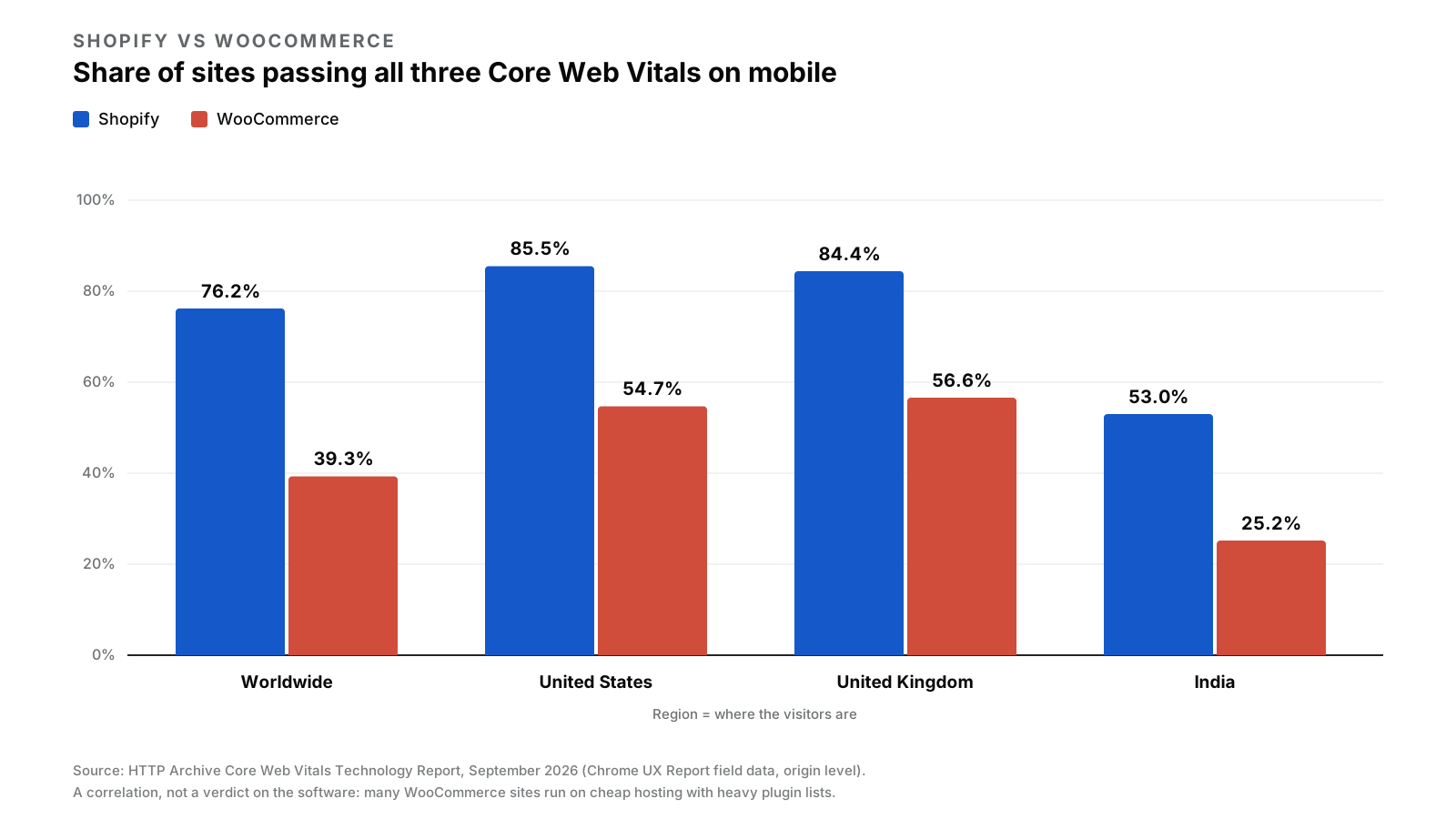
Chart — the mobile columns of the table above. Source: HTTP Archive Core Web Vitals Technology Report, September 2026.
This is a correlation, not a verdict on the software. Many WooCommerce stores run on cheap hosting with long lists of plugins, and a well-built WooCommerce store on good hosting can be fast. But the default outcome differs. On Shopify, hosting and the content delivery network are handled for you. On WooCommerce, speed depends on choices you make. If you go with WooCommerce, budget for proper hosting and a lean plugin list from the start.
Which is more secure, Shopify or WooCommerce?
Shopify carries more of the burden for you:
- Shopify says it is “certified Level 1 PCI DSS compliant” and that this “extends by default to all stores powered by Shopify”, covering the store, cart and hosting. Platform security and server maintenance are Shopify’s job.
- WooCommerce is clear that “PCI DSS compliance is ultimately the responsibility of the store owner”. Using hosted payment fields reduces that scope but doesn’t remove it.
The bigger WooCommerce risk is the plugins around it. Patchstack’s State of WordPress Security in 2026 counted 11,334 new vulnerabilities in the WordPress ecosystem in 2025, up 42%:
- 91% were in plugins and 9% in themes.
- Only 6 were in WordPress core.
- 46% had no fix from the developer by the time they were made public.
A WooCommerce store is as secure as its least-maintained plugin. Keep the plugin list short, prefer well-maintained ones, and update promptly.
Which handles AI shopping better in 2027?
Shopify is ahead today. Its stores can sell through Microsoft Copilot, Google AI Mode and Gemini, and Meta with a direct checkout inside the AI channel. ChatGPT sends shoppers to the store’s own checkout. Our post on AI checkout and subscriptions covers the details and limits.
WooCommerce is building its equivalents. Its agentic commerce page lists:
- Abilities API: live.
- MCP: beta. It lets AI assistants help manage a store, not check shoppers out.
- Google’s Universal Commerce Protocol: “coming soon”.
- Stripe’s Agentic Commerce Protocol: being rolled out to selected merchants through the Stripe plugin. WooCommerce notes that stores using WooPayments can’t use it yet.
If selling through AI assistants matters to you in 2027, Shopify gets you there now. WooCommerce may catch up, but it isn’t there yet.
What has changed in WooCommerce recently?
WooCommerce is on version 11 in late 2026, with more than seven million active installs (WordPress.org). Two changes from recent years matter if you’re comparing against an older review:
- High-Performance Order Storage has been on by default for new stores since version 8.2 in October 2023. Orders get their own database tables rather than sharing WordPress’s posts table.
- Block-based cart and checkout have been the default for new installs since version 8.3, although stores that upgraded kept their old checkout.
Older stores may have neither, which is worth checking before you judge WooCommerce on an old build.
How many stores use each platform?
It depends how you count. Among websites whose content system W3Techs can identify, WooCommerce runs on 11.5% and Shopify on 7.9%. WooCommerce’s lead partly reflects how many WordPress sites have it installed, whether or not they sell much. Counting only live stores, Store Leads finds 4.3 million on WooCommerce, down 10% year on year, and 3.2 million on Shopify, up 15%. WooCommerce is bigger, and Shopify is growing.
When does WooCommerce win?
WooCommerce is the better choice when:
- Content is the business. A publisher, course creator or brand with years of WordPress content can add a store without moving everything.
- You need full control of the code, the database and the checkout logic, and you have the budget for the developer that control requires. Shopify gives deep checkout control only on Plus.
- You sell in India on a lower Shopify plan, where the extra third-party payment fee is a real cost.
- You already have someone who maintains WordPress well.
Shopify is the better choice when:
- No one on the team wants to own hosting, updates or security.
- Speed and stability out of the box matter more than control.
- You want to sell through AI channels, Shop Pay, Shopify POS and Shopify’s app ecosystem now.
- You plan to grow fast and don’t want the platform to become a project.
How do you move from WooCommerce to Shopify without losing search traffic?
Shopify’s free Store Migration app imports WooCommerce products and customers from CSV files. Know the limits before you start:
- Products: Shopify allows at most three options per product. A WooCommerce product with four or more variation attributes is imported without variants.
- Orders and coupons can’t be imported by CSV. Use a migration app or a developer for order history.
- Blog posts, pages and product reviews aren’t in WooCommerce’s exports and need moving separately.
- Customer passwords can’t be migrated. Customers set new ones.
- Redirects can be imported by CSV. Build the map of old URLs to new ones before launch. It’s what protects your rankings.
Moving the other way, from Shopify to WooCommerce, has the same redirect requirement. Whichever direction you go, the URL map is the deliverable not to skip. Our Shopify development cost guide explains why it belongs in any migration quote.
Getting help with either platform
We build on both, so we have no reason to push you to one. Our WordPress and WooCommerce development starts at $799, and Shopify theme development at $999. If you’re deciding between them, or thinking about moving, book a free 30-minute call and we’ll tell you which fits how your team actually works.
FAQs
Is Shopify or WooCommerce better in 2027?
It depends on who will run the store. Shopify is better for teams without a developer, because it handles hosting, security and updates, and it is ahead on AI shopping channels. WooCommerce is better for content-heavy WordPress businesses and for teams that need full control of the code and data and have someone to maintain it.
Is WooCommerce cheaper than Shopify?
Not always. WooCommerce itself is free, but a store needs proper hosting (about $45–$150 a month on managed plans), often paid extensions such as Subscriptions at $279 a year, and regular maintenance. Shopify’s US plans start at $39 a month with hosting and security included. In India, WooCommerce often costs less per order because Shopify charges an extra fee when Shopify Payments isn’t available.
Which is faster, Shopify or WooCommerce?
In real-world data, Shopify stores pass Google’s Core Web Vitals far more often. In HTTP Archive’s September 2026 report, 76.2% of Shopify sites passed on mobile worldwide, against 39.3% of WooCommerce sites. A WooCommerce store on good hosting with few plugins can be fast, but on Shopify that’s the default.
Which is more secure, Shopify or WooCommerce?
Shopify handles platform security and PCI compliance for every store. On WooCommerce, PCI compliance is the store owner’s responsibility, and most risk comes from plugins. Patchstack counted 11,334 new WordPress ecosystem vulnerabilities in 2025, 91% of them in plugins, so a WooCommerce store needs a short, well-maintained plugin list and prompt updates.
Is Shopify or WooCommerce better for an Indian store?
On a lower Shopify plan, WooCommerce is usually cheaper per order. Shopify Payments isn’t available in India, so Shopify adds a 2% fee on Basic on top of a gateway such as Razorpay, for about 4.36% per order against about 2.36% on WooCommerce. Shopify’s fee falls on higher plans, and Shopify includes hosting, speed and security that WooCommerce stores pay for separately.
Can I move from WooCommerce to Shopify without losing SEO?
Yes, if you redirect every old URL to its new one. Shopify’s free Store Migration app imports products and customers, and redirects can be imported from a CSV file. Orders, coupons, blog posts and reviews need moving separately, and customers will need to set new passwords.
Does WooCommerce work with ChatGPT and AI shopping?
Partly, and less than Shopify in late 2026. WooCommerce lists its Abilities API as live and its MCP support in beta, while Google’s Universal Commerce Protocol is “coming soon” and Stripe’s Agentic Commerce Protocol is rolling out to selected merchants. Shopify stores can already sell through direct checkouts in Copilot, Google AI Mode and Meta.
Written by Vibhora
Shopify development, branding, custom apps, SEO, paid ads and store care for small and growing brands - one team, fixed published prices.